
Key Points:
- Reparation Generation, a national nonprofit, aims to help Black descendants of enslaved people in the U.S. purchase homes in metro Detroit with $25,000 and genealogy consultation.
- The nonprofit seeks to create a model for national reparations.
- Detroiters in 2021 voted to create a reparations task force to address historical discrimination faced by Black residents, signaling an interest in reparations.
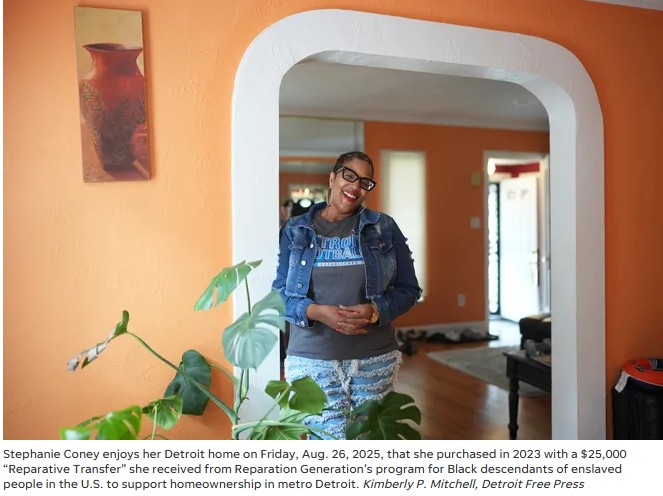
When Detroiter Stephanie Coney applied for a homeownership program a few years ago, she not only received $25,000 that went toward the mortgage of her brick home in northwest Detroit but got access to her roots.
In 2023, Coney was selected for the program through Reparation Generation. The national nonprofit wants to create wealth for Black Americans, in part, by providing descendants of enslaved people in the U.S., living in metro Detroit, with homeownership funding and genealogy tracing. Six new recipients were selected last month for the third round of the program and Reparation Generation is looking to fund four more by the end of the year.
Reparation Generation — a project of California-based nonprofit Multiplier — was founded in 2020 in the wake of the murder of George Floyd, a Black man killed by a former Minneapolis police officer. A group of people, Black and white from Detroit, California and a couple other cities, came together to develop what would become the organization on a mission to build wealth for Black Americans and provide data for a potential federal reparations program.
Story by, Nushrat Rahman | Detroit Free Press – 10/15/2025
Homeownership Reparative Transfer (HORT) Program.
A New Phase of Action Toward Repair
While federal Reparations remain our long-term goal, Reparation Generation (RepGen) is acting now to demonstrate what real repair can look like in people’s lives today. The HORT Program is one of RepGen’s flagship models, providing one-time, $25,000 Reparative Transfers, homebuyer mentorship, Restorative Genealogy and other critical support to Black Descendants of Enslaved People in the U.S. purchasing a primary residence in Metro Detroit.
Grounded in the United Nations Reparations principle of compensation, the HORT Program aims to create replicable and scalable models that provide partial compensatory repair to Black Descendants of Enslaved People in the U.S.

Why Detroit?
Detroit’s complicated racial history illustrates the array of issues underlying racial injustice and disparity in America. As a city that saw a large number Black migrants during the great migration, Detroit is the home to direct descendants of enslaved Americans and those targeted by Jim Crow laws in the South. Structurally racist policies and practices in Detroit, like redlining and race-based housing covenants, served to segregate and economically oppress Black residents. The effects persist today: Detroit’s population, job, and housing markets mirror those in other industrial Great Migration cities like Cleveland, Philadelphia, Chicago, and Baltimore, making it a good location to demonstrate the impact and scalability of Reparation Generation’s initiatives.

SOURCE: Reparations Generation https://reparationgeneration.org/
 Living Islam
You must be logged in to post a comment.