
“My father introduced me to husbands since I was twelve.” – Sudanese female on her forced marriage at age 17
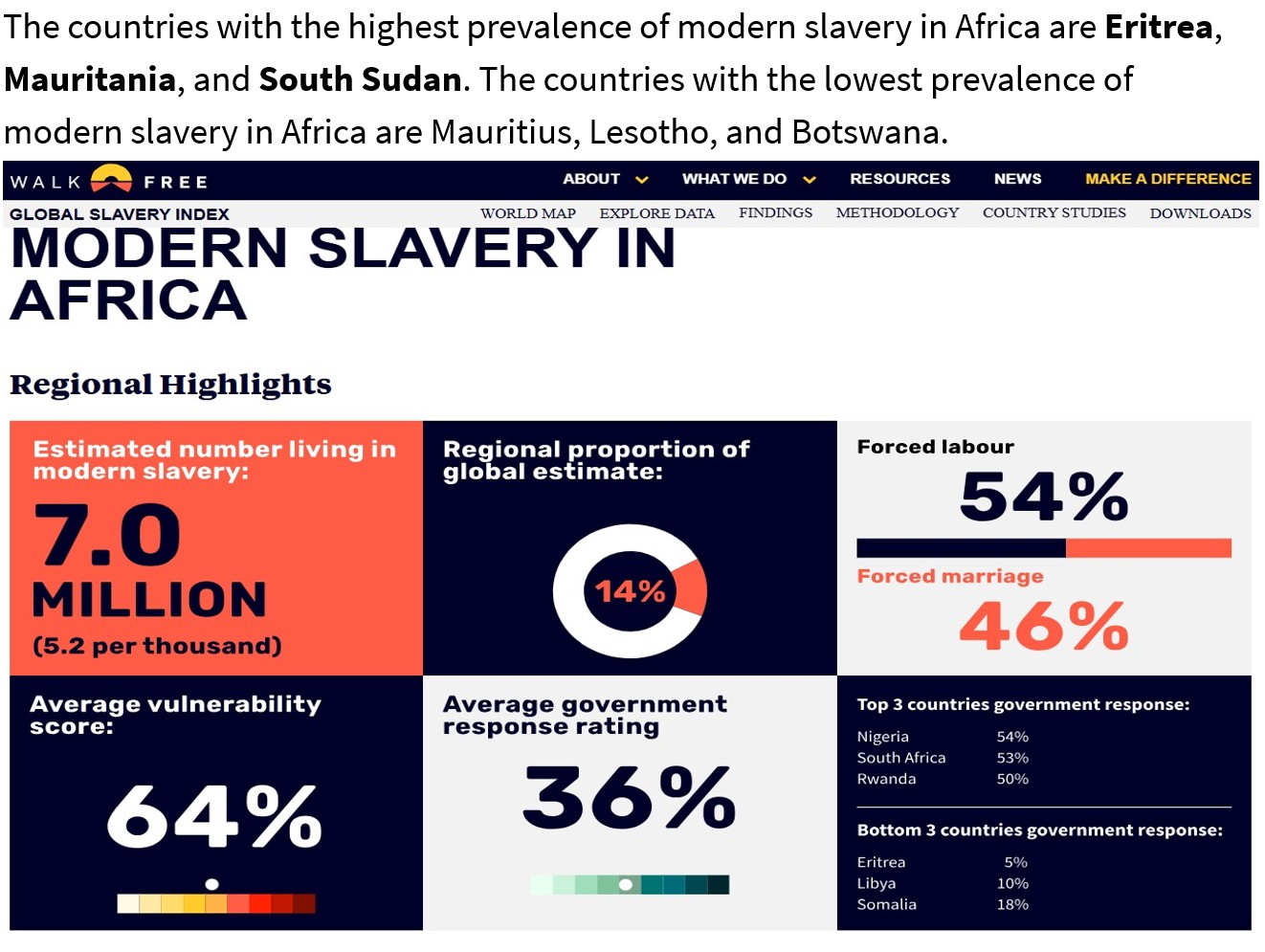
Africa is a vast and diverse region that accounts for 17 per cent of the world’s population. Modern slavery in Africa is driven by ongoing political instability, poverty, displacement of people due to conflict and climate change, and the impact of the COVID-19 pandemic. Modern slavery manifests differently throughout Africa; it occurs in every country in the region, while those with higher prevalence typically experience compounding vulnerability factors. More than 3.1 million Africans are in forced marriage, the drivers of which depend on factors in their location, such as the presence of conflict, poverty, or persistence of certain traditional practices. There are more than 3.8 million people in forced labour across Africa. At particularly high risk are adults and children who travel from rural and remote areas to urban centres seeking work. Higher rates of descent-based slavery and forced begging continue to occur in parts of the Sahel.
Over the past four years, many African countries have taken actions to improve their response to modern slavery. Nigeria and South Africa have taken the most action, while Eritrea and Libya have taken the least. South Sudan was excluded from the assessment of government action on modern slavery due to ongoing conflict and extreme disruption to government function. Much more needs to be done to provide support for survivors, strengthen laws to protect people, and develop national strategies to combat modern slavery.
What is the extent and nature of modern slavery in Africa?
On any given day in 2021, an estimated 7 million men, women, and children were living in modern slavery in Africa, a prevalence of 5.2 people in modern slavery for every thousand people. Africa had the fourth highest prevalence of modern slavery among the five regions of the world, following the Arab States (10.1 per thousand), Europe and Central Asia (6.9), and Asia and the Pacific (6.8). Forced labour was the most common form of modern slavery in the region, at a rate of 2.9 per thousand people, while forced marriage was at 2.4 per thousand.
When considering the total number of people in forced marriage worldwide, 13 per cent (3.2 million) were in Africa, second to Asia and the Pacific, which at 65 per cent has by far the highest share of the world’s forced marriages. Fourteen per cent of all people in forced labour were in Africa (3.8 million), the third highest behind Asia and the Pacific (55 per cent) and Europe and Central Asia (15 per cent).
The countries with the highest prevalence of modern slavery in Africa are Eritrea, Mauritania, and South Sudan. The countries with the lowest prevalence of modern slavery in Africa are Mauritius, Lesotho, and Botswana.
How is forced labour affecting millions in Africa?
Nearly 4 million men, women, and children experience forced labour in Africa, particularly in the mining, agriculture, fishing, and domestic work sectors.1 African job seekers misled by traffickers with false promises are subjected to forced labour abroad, such as in the Gulf states.2 Children are also exploited in their pursuit of education. For example, under the confiage (trust) system in Togo, children from rural areas are sent to cities to complete their education and live with relatives, who may force them into domestic servitude.3 Nigerian girls seeking employment as domestic helpers to help pay for schooling are also subjected to domestic servitude.4 In Senegal, talibe (student, seeker) children in Quranic schools are forced to beg.
How does forced marriage in Africa impact women and girls?
In Africa, forced marriage particularly impacts women and girls. One in every 300 females in the region was in a forced marriage compared to one in every thousand males.6 In the aftermath of the COVID-19 pandemic, reports of child marriages increased in Sudan, Egypt,7 and parts of the Democratic Republic of the Congo (DRC),8 and they nearly doubled in communities across Senegal and Uganda.9 Women and girls living in conflict zones also experience forced and child marriage, including as a negative coping mechanism by families to protect them from further violence10 and by fighters who abduct, marry, and exploit women and girls as domestic and sexual slaves.11 Forced commercial sexual exploitation of women and girls is used as a weapon of war by both state and non-state groups, reportedly in the Central African Republic, the DRC, Somalia, South Sudan, Sudan,12 and by both parties to the civil war in Ethiopia’s Tigray region.13
“My father introduced me to husbands since I was twelve.”
Sudanese female on her forced marriage at age 17
Although these figures are the most reliable to date, they are conservative estimates given the gaps and limitations of data collection in Africa. It is not possible to conduct nationally representative surveys in countries experiencing profound conflict, which leads to an underestimate of forms of modern slavery such as the recruitment of child soldiers. Despite gaps in data, reports indicate children have been recruited into armed groups in the DRC, Mali, Central African Republic, Mozambique, Nigeria, Libya, South Sudan, Sudan, Niger, Cameroon, Chad, Burkina Faso, and Somalia. https://www.walkfree.org/global-slavery-index/findings/regional-findings/africa/?fbclid=IwY2xjawKA0XhleHRuA2FlbQIxMQBicmlkETFYM1o3WXcyMHRhUHFzbnBUAR6SrsasDVsWzeykKcx8s3_NZJ8WFsSUthNtp4k1uUSzkxbmVnk-PkD7RZXFcQ_aem_18_RMNx-5TZEpeUdH_2vRA
AFRICA | WALK FREE

 Living Islam
You must be logged in to post a comment.